November 20th, 2011
INTRODUCTION
With the current emphasis on biomass usage as a `green’ fuel for energy plants, it has become apparent that there is a need for understanding the requirements for storing biomass. Woody biomass, called `hog fuel’, has long been utilized as a fuel in cogeneration plants at pulp and paper mills, where it was traditionally a waste product from the processing of clean white wood chips used to make pulp. While many practical lessons have been learned about what is appropriate for hog fuel storage, generally little documented study has been directed at storage practices, primarily due to its abundance and historical status as a waste product with next to zero value.
However, hog fuel is the basic feedstock for biomass-fired power plants and is becoming a hot commodity and it is the single biggest on-going cost item for energy plants. How it is handled has an effect on quality, so a greater understanding of hog fuel storage requirements is required. Read the rest of this entry »
July 30th, 2011
Where any bulk, raw resource is used in an industrial process, there is a requirement to track both usage and inventory. And with the increased movement to utilizing biomass as a fuel source, more companies are discovering the difficulty in accurately measuring biomass inventory.
The traditional method of determining inventory has been to measure the volume of a pile and from that back-calculate the tonnage. However, accurately determining the amount of fibre in biomass piles has long been problematic and even today with accurate measuring devices, fibre measurement doesn’t have an easy solution.
Pulp and paper mills everywhere have struggled with this problem for years. One year they will have to write-off wood chip inventory that appears to have disappeared; the next year they will have too much inventory. Other facilities that utilize biomass have similar inventory assessment problems.
Volume Measurement
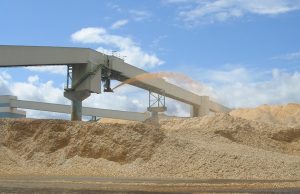
Pile size and volume is measured by surveying and years ago the lack of accuracy was accepted and used to explain inventory variances. With current measuring technology, the volume measurement accuracy has greatly improved and yet the estimate of actual fibre remaining in the pile is still not very accurate. Generally, the problem lies with not knowing the amount of compaction and the consequent density inside the pile. Without this knowledge, back-calculating tonnage from a volume measurement is quite `hit and miss’. Read the rest of this entry »
January 8th, 2011

Rocks from Scalping Screen
This article appeared in the November / December 2011 issue of Canadian Biomass magazine. www.canadianbiomassmagazine.ca
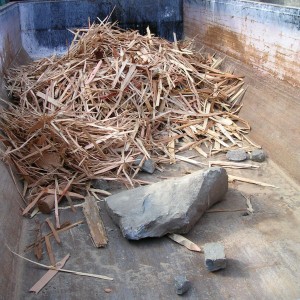
The recent upsurge of interest in biomass-fired power plants is accompanied by a corresponding increase of interest in methods for removing non-combustible, non-organics such as rocks, stones, sand and grit from woody biomass. Rock contaminated woody biomass has long been a problem, and many ways have been attempted in trying to deal with it. The methods are varied, usually depending upon the end-use to which the biomass is being put. There are some specific methods that are very successful; others more a measure of how best to accommodate the problem.
Following is a brief description of the most common methods industry has utilized for removing such non-organics from woody biomass. Read the rest of this entry »
November 14th, 2010
A Beginner’s Guide to the Project Development Process
Author: Paul Janzé
An editted version of this article appeared in the November / December 2011 issue of Bioenergy Insight magazine, under the title “Building a Biomass Plant”. http://bioenergy-news.com/
You have a good idea for a new way to manufacture a product. Or, your friend has spotted a market opportunity. All you have to do is build a plant and start producing. “Build it and they will come.” Sounds simple. How can you miss?
Easily, I must say. The days are long gone when developing a project was as simple as pitching an idea to a bank, getting some cash, building a plant and selling your product.
With the current emphasis on producing `green energy’ from biomass and the subsequent government grants and subsidies available to promote the idea, a lot of well-meaning but inexperienced entrepreneurs are promoting the construction of plants that will process biomass into one form or another.
There are some basic steps that all projects go through, from concept to start-up, whether the `builder’ is new to the process or whether it is a company with a well formulated plan for development. Following is a brief description of the project development process. Read the rest of this entry »
October 3rd, 2010
An edited version of this article was published under the title “Handle with care” as a feature article in the UK “Bioenergy Insight” magazine, Volume 1, Issue 1, October 2010.
It’s fair to say that Europe is a decade ahead of the rest of the world when it comes to ‘green’ issues, and no more so than in the area of renewable energy sources, particularly utilizing woody biomass as a source of fuel.
Europe is an interesting case, as on one hand, it is the world leader on green issues and has vigorously promoted biomass as an alternative fuel; and on the other hand, it is far from sufficient sources of woody biomass.
As a contrast, Canada has a tremendous amount of woody biomass. And, for decades residual wastewood has been well-utilized as a fuel source for industrial plants. However, there is little incentive in Canada to utilize standing forests for fuel as we have such a small population, and an abundant supply of low-cost energy, for example, hydro power in BC, oil in Alberta, nuclear power in Ontario.
Likewise, Russia and the southeastern USA have large amounts of wood fibre available that can be used for energy production. Read the rest of this entry »
May 24th, 2010
This article was published under the title “Move Your Biomass” as the cover story in the May – June 2010 issue of Canadian Biomass Magazine. Read it online at:
http://www.canadianbiomassmagazine.ca/index.php?option=com_content&task=view&id=1781&Itemid=132
Biomass is not an easy material to handle. It
appears in a myriad of species, forms and sizes; it knits together, doesn’t flow well, consolidates and packs easily; it can have a wide range of moisture contents, basic and bulk densities and calorific values; it will freeze; it is very dusty, catches fire easily and is self-combustible; it can contain all manner of contaminants. Conversely, wood pellets are uniform in size and moisture content, are very free flowing, but are quite fragile and easily degrade and require special handling.
Increasing numbers of power utilities are eyeing biomass as a source of fuel, primarily as a means of lowering CO2 emissions. New biomass boilers are being constructed but many coal-fired boilers are being converted for co-firing biomass or converted to 100% biomass. Biomass can be introduced into combustors as `hog fuel’, wood pellets or injected as a powder. Working in the forest and converting the wood into usable products is part of the Canadian heritage. There are many people and companies who have extensive experience handling woody biomass in all its myriad of forms. However, with the recent rush to `green energy’ and the identification of woody biomass as a green fuel, there are a lot of interested and well-intentioned but woefully inexperienced people vying for various grants and proposing new projects, but who have little or no experience with biomass.
Care must be taken in the design of your biomass handling system whatever the form. The topic of design is as varied and complex as the material and the intent in this article is to cover woody biomass, in the form of hog fuel and pellets, which is utilized as fuel. I will discuss the subject in a broad-brush manner suitable for this publication. Following is a list and short description of things to consider when designing your system. Read the rest of this entry »
April 18th, 2010
Designing belt conveyors for use in extreme northern environments requires special care. For example, temperatures in northern Canada can vary between -45°C in winter to +35°C in summer. In winter, snow load, blowing snow and ice build-up are always problems to be encountered. The product being handled can have ice particles frozen to it and can also contain loose snow. And at such extreme temperatures, steel becomes very brittle and susceptible to damage from impacts.
In warmer climates, you can always push the design limits and use short, steep, small, high speed conveyors. In extreme cold climates, simultaneously pushing all design limits is a recipe for disaster.
In extreme cold climates it’s best to be conservative in your design. Following is a list of `do’s and don’ts, which I have learned over the years. Read the rest of this entry »
April 18th, 2010
Introduction
With the current emphasis on the use of biomass for `green’ energy purposes, the importance of having good quality `hog fuel’, cannot be over-emphasized. And to ensure good quality fuel, good sampling procedures must be followed.
Woody biomass in chip form has been utilized by the pulp and paper industry for many decades and chip quality has long been recognized as having an important effect on pulp quality; to make good pulp you need good chips. Likewise for a biomass-fired plant to operate efficiently, it needs a reliable, constant supply of consistent quality fuel.
This paper was originally written with the pulp and paper industry in mind; however, the fundamentals of sampling wood chips also apply to the requirements of sampling biomass to be utilized as fuel.
In the past couple of decades, two opposing phenomena have emerged concerning the fibre supply for pulp and paper mills.
- The supply of wood chips has shifted dramatically from high quality, whole log chips produced by a pulpmill woodroom, to residual chips from other processing industries, primarily sawmills. Residual chips can present considerable problems to the pulp mills.
- The pulp mills have long known that wood chips of a certain size and configuration produce a better wood pulp and have been demanding a better quality product from their fibre suppliers.
Consequently, quality control of chip supply has become more important and more difficult as most mills have multiple sources for their fibre.
Read the rest of this entry »